
Description
Key Features
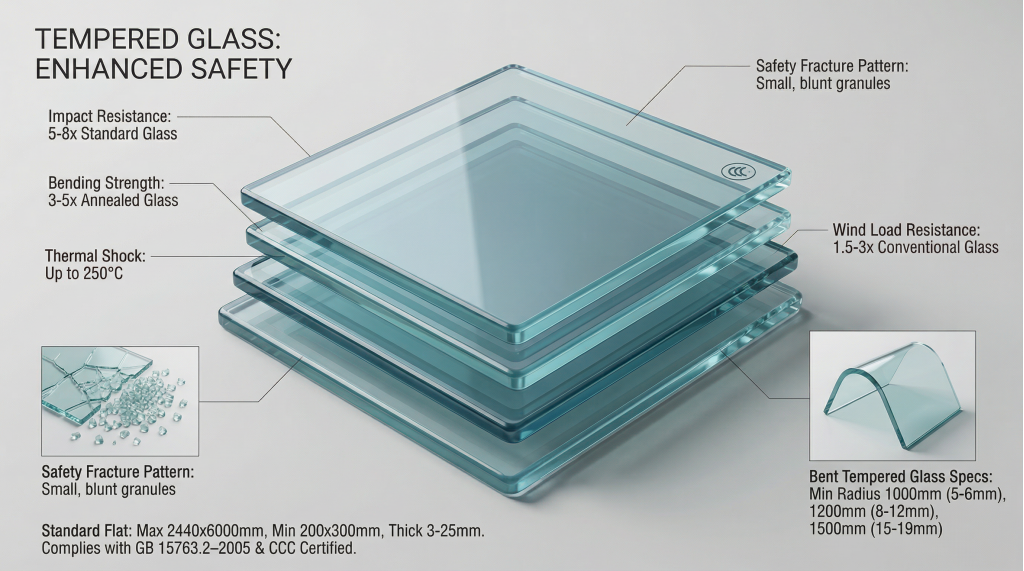
- · Enhanced Safety: Upon breakage, tempered glass fractures into small, blunt-edged granules rather than sharp shards, minimizing the risk of injury.
- · High Mechanical Strength:
- Bending strength: 3–5 times that of annealed (ordinary) glass
- Impact resistance: 5–8 times greater than standard glass
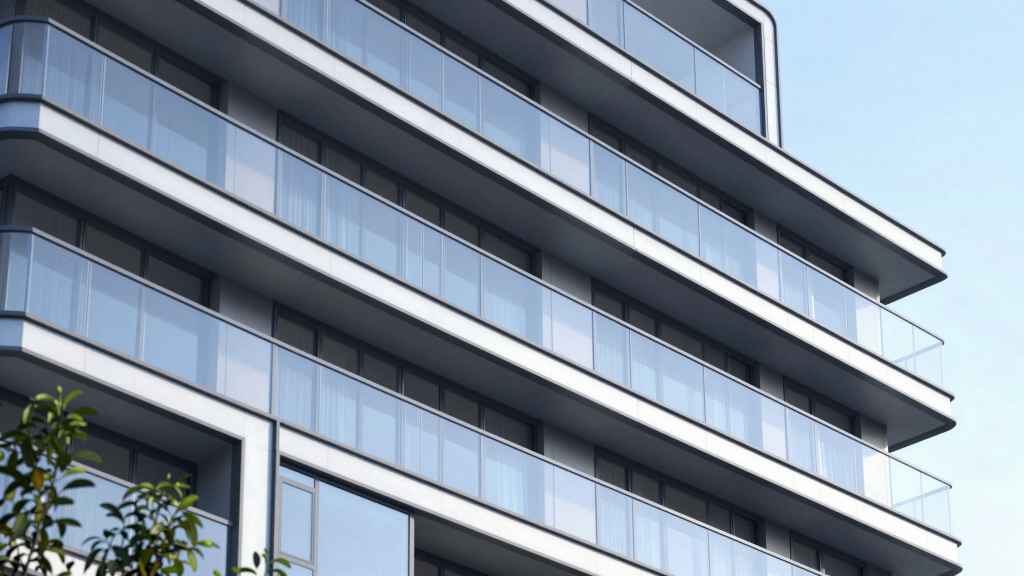
- · Superior Wind Load Resistance: Withstands wind pressures 1.5–3 times higher than conventional glass, making it suitable for high-rise and exposed façades.
- · Excellent Thermal Shock Resistance: Capable of enduring temperature differentials up to 250°C, offering approximately 3 times the thermal shock resistance of ordinary glass.
Applications
As a certified safety glass, tempered glass is widely specified in environments requiring durability, structural performance, and occupant protection, including:
- · Glass doors and frameless entrances
- · Building curtain walls and façades
- · Interior partitions and balustrades
- · Elevator cabins and vision panels
- · Windows and glazed building envelopes
- · Furniture (e.g., tabletops, shelves)
- · Household appliances (oven doors, refrigerator panels, etc.)
Standard Flat Tempered Glass Specifications
- · Maximum Size: 2,440 mm × 6,000 mm
- · Minimum Size: 200 mm × 300 mm
- · Thickness Range: 3 mm – 25 mm
Bent (Curved) Tempered Glass Specifications
- · Thickness Range: 5 mm – 19 mm
- · Maximum Size: 2,400 mm × 2,500 mm
- · Minimum Size: 400 mm × 600 mm
- · Minimum Bending Radius:
- 1,000 mm for 5–6 mm thickness
- 1,200 mm for 8–12 mm thickness
- 1,500 mm for 15–19 mm thickness
Quality & Compliance
- · Complies with GB 15763.2–2005: Safety Glass for Buildings – Part 2: Tempered Glass (China National Standard)
- · Certified under the China Compulsory Certification (CCC) for safety glass products
Reviews
There are no reviews yet.